
Tracking Organized Fraud Networks Across Borders
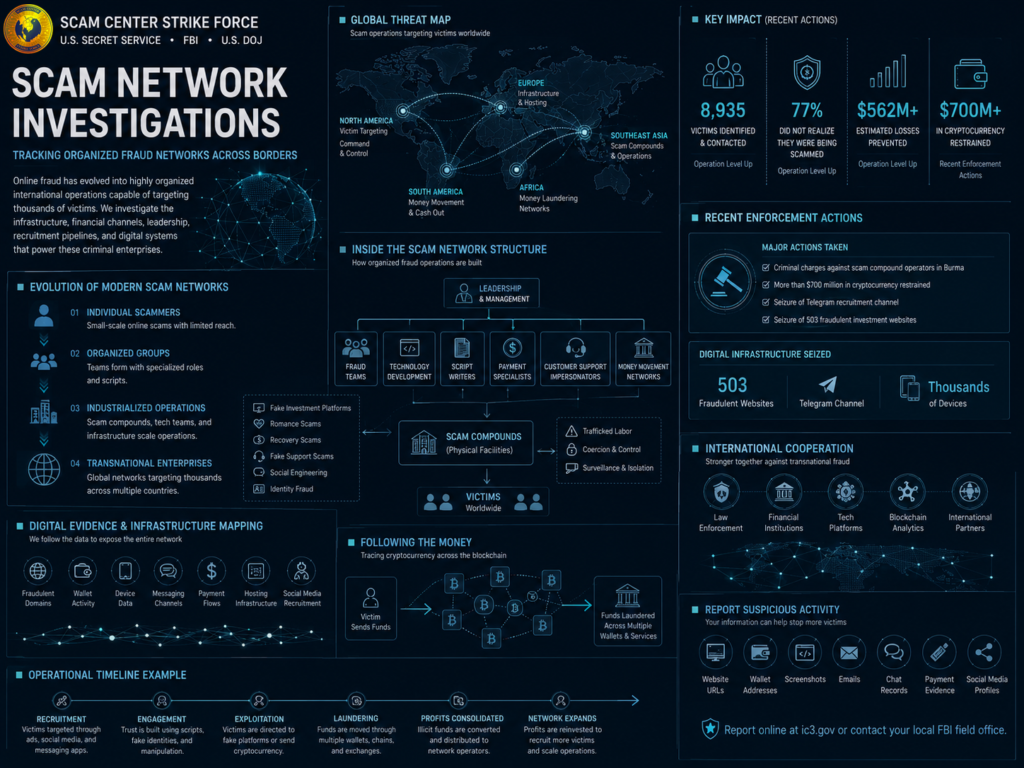
Online fraud has evolved from isolated criminal activity into highly organized international operations capable of targeting thousands of victims simultaneously.
Scam Network Investigations focuses on identifying the infrastructure, financial channels, operational leadership, recruitment pipelines, and digital systems that support large-scale online fraud.
Recent federal investigations have revealed that many modern fraud operations function more like organized enterprises than traditional cybercrime groups.
The Evolution of Modern Scam Networks
Over the last several years, investigators have documented the expansion of large-scale fraud operations operating across multiple jurisdictions.
These organizations commonly engage in cryptocurrency investment fraud, romance scams, fake trading platforms, recovery scams, customer support impersonation, social engineering operations, money laundering, and identity fraud.
According to the U.S. Department of Justice, many of these operations target American victims while operating from organized scam compounds located across Southeast Asia.
Inside the Scam Compound Model
Investigations have identified an industrialized fraud model involving physical compounds operating across regions of Southeast Asia.
Authorities describe these operations as structured environments containing fraud teams, technology development units, script writers, cryptocurrency payment specialists, customer support impersonation groups, and money movement networks.
Reports describe some facilities as relying on trafficked labor and coercion to sustain fraud operations.
Recent U.S. Enforcement Actions
Federal authorities announced coordinated actions targeting scam infrastructure and operators connected to Southeast Asian fraud networks.
Publicly announced actions included criminal charges against two alleged operators linked to a fraud compound in Burma, restraint of more than $700 million in cryptocurrency, seizure of a Telegram recruitment channel, and seizure of 503 fraudulent investment websites targeting victims in the United States.
Operation Level Up
Operation Level Up is an initiative led by federal agencies to proactively identify and notify victims of cryptocurrency investment fraud.
Publicly released figures reported that 8,935 victims were identified and contacted, 77% did not realize they were being scammed, and authorities estimated prevention of more than $562 million in additional losses. Victims experiencing severe financial and emotional harm were also referred for specialized support.
Digital Evidence and Infrastructure Mapping
Modern investigations no longer focus only on individuals.
Investigators increasingly examine fraudulent domains, wallet activity, device data, messaging channels, payment flows, hosting infrastructure, and social media recruitment patterns.
Federal reporting described analysis of thousands of seized devices and interviews conducted after compound disruptions to map command structures and operational methods.
International Cooperation
Disrupting transnational scam networks requires cooperation across government and private sectors.
Investigations may involve law enforcement agencies, financial institutions, technology platforms, blockchain analytics providers, internet service providers, and international partners.
Recent disruption campaigns have included account removals, sanctions, domain seizures, and intelligence sharing across multiple countries.
Public Awareness and Prevention
Scam networks continue adapting rapidly.
Common warning signs include investment guarantees, requests for cryptocurrency transfers, unverified websites, pressure to act immediately, conversations moved to private messaging applications, and additional payments required to release funds.
Early reporting and preservation of evidence remain essential.
Report Suspicious Activity
If you encounter a suspected scam network, preserve website URLs, wallet addresses, screenshots, emails, chat records, payment evidence, and social media profiles.
Information shared through public reporting can assist investigators in identifying broader criminal patterns and preventing additional losses.