When the Person Helping You Is Actually the Scammer
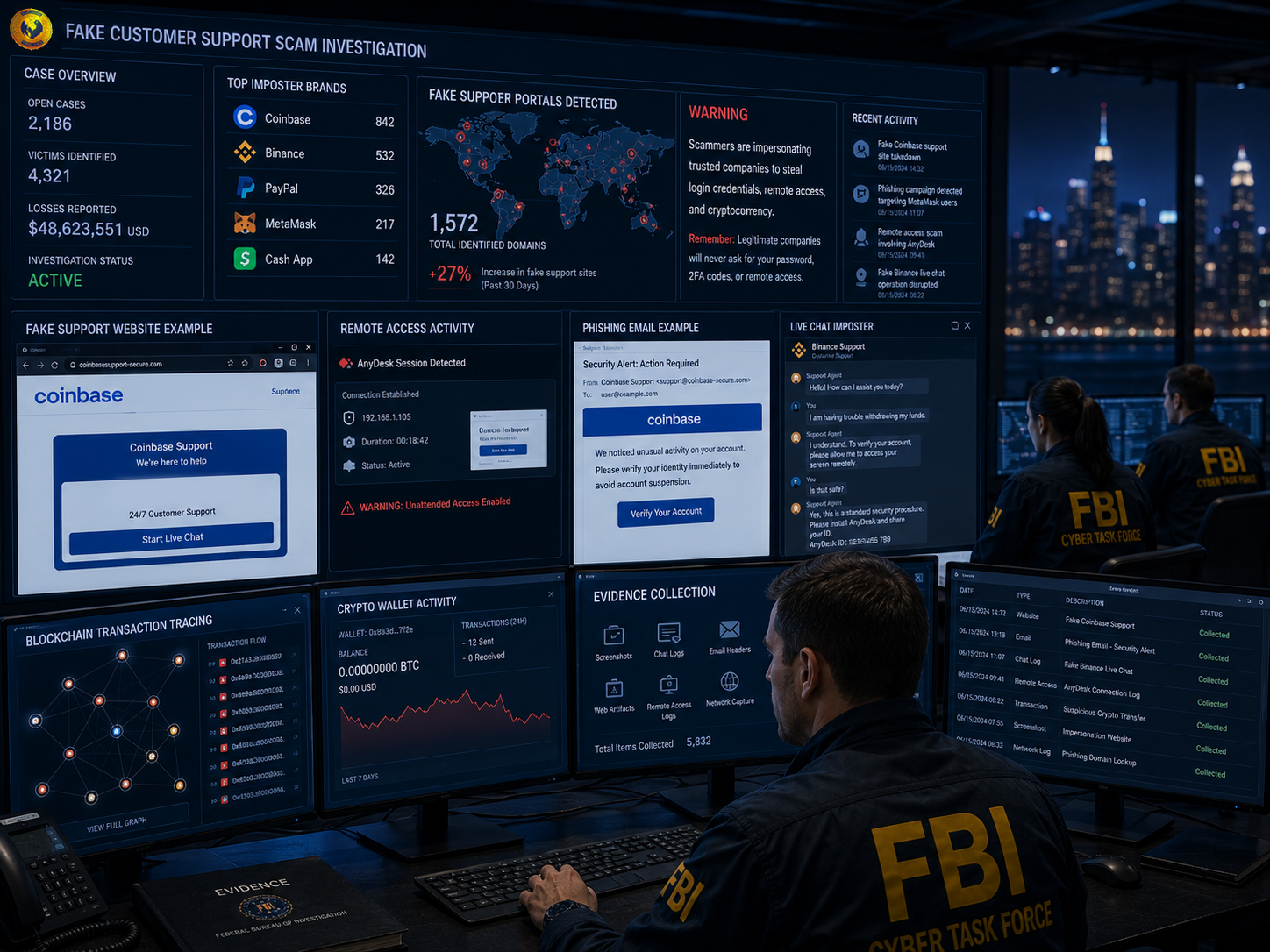
Fake Customer Support scams have become one of the most dangerous forms of online fraud in recent years. Criminals impersonate legitimate customer service representatives from cryptocurrency exchanges, banks, technology companies, government agencies, and financial institutions to steal money, login credentials, personal information, and cryptocurrency assets.
Victims often believe they are communicating with official support staff when, in reality, they are speaking directly with fraudsters.
As cryptocurrency adoption and digital banking continue to grow, fake customer support operations have become a major threat to consumers across the United States.
A Growing Cybercrime Threat
Over the last several years, federal investigators have observed a significant increase in customer support impersonation scams.
These fraud schemes commonly target users of:
- Cryptocurrency Exchanges
- Online Banking Platforms
- PayPal and Payment Services
- Investment Applications
- Social Media Platforms
- E-commerce Websites
- Technology Companies
- Government Services
Criminals exploit confusion, urgency, and trust in established brands to manipulate victims into surrendering sensitive information.
Why Fake Support Scams Are So Effective
Unlike traditional scams, victims often initiate contact themselves.
When searching online for support numbers, victims may unknowingly find:
- Fake Google advertisements
- Fraudulent support websites
- Scam phone numbers
- Impersonation social media accounts
- Fake Telegram channels
- Fraudulent WhatsApp contacts
Believing they are contacting legitimate support, victims unknowingly connect directly with scammers.
How Fake Customer Support Scams Work
Stage 1: The Problem
The victim experiences an issue such as:
- Account Login Problems
- Cryptocurrency Withdrawal Delays
- Frozen Funds
- Suspicious Transactions
- Password Resets
- Security Alerts
- Technical Errors
Seeking assistance, the victim searches online for customer support.
Stage 2: The Fake Support Representative
The fraudster presents themselves as:
- Exchange Support Staff
- Bank Security Personnel
- Fraud Investigation Specialists
- Account Recovery Agents
- Technical Support Representatives
- Government Employees
The scammer often speaks professionally and appears highly knowledgeable.
Stage 3: Establishing Trust
To appear legitimate, scammers may provide:
- Fake employee IDs
- Ticket numbers
- Verification codes
- Official-looking emails
- Corporate logos
- Security warnings
The objective is to convince the victim they are dealing with an authorized representative.
Stage 4: Information Gathering
The scammer requests:
- Login credentials
- Passwords
- Authentication codes
- Recovery phrases
- Wallet seed phrases
- Identity documents
- Banking information
- Remote computer access
Legitimate companies never request many of these items.
Stage 5: Account Takeover
Once access is obtained, scammers may:
- Transfer cryptocurrency
- Change passwords
- Disable security settings
- Withdraw funds
- Steal personal information
- Access linked financial accounts
By the time victims realize what happened, assets may already have been moved through multiple wallets or financial channels.
Cryptocurrency Customer Support Fraud
Cryptocurrency users are among the most frequently targeted groups.
Fraudsters commonly impersonate:
- Coinbase Support
- Binance Support
- Kraken Support
- Gemini Support
- Crypto.com Support
- Blockchain Wallet Support
- MetaMask Support
Victims searching for help online may encounter fraudulent websites designed specifically to imitate legitimate support portals.
The Numbers Behind the Fraud
Federal agencies continue to receive thousands of complaints annually involving impersonation and customer support scams.
Recent trends show:
- Significant increases in cryptocurrency support fraud.
- Growing use of fake social media support accounts.
- Increased targeting of senior citizens and first-time crypto investors.
- Expansion of scam operations using WhatsApp and Telegram.
- Millions of dollars in reported annual losses tied to impersonation schemes.
Many incidents go unreported, meaning actual losses may be substantially higher.
Organized Criminal Networks
Investigations have linked many customer support scams to organized cybercrime groups operating internationally.
These networks often maintain:
- Fake support websites
- Fraud call centers
- Social media impersonation teams
- Cryptocurrency laundering operations
- Phishing infrastructure
- Remote access fraud operations
Some organizations operate around the clock targeting victims across multiple countries.
Common Customer Support Scam Tactics
Warning Signs
| ⚠ Unsolicited calls claiming account problems | ⚠ Requests for passwords |
| ⚠ Requests for recovery phrases | ⚠ Pressure to act immediately |
| ⚠ Requests for remote computer access | ⚠ Cryptocurrency payment requests |
| ⚠ Unofficial support channels | ⚠ Poorly verified websites |
| ⚠ Requests to disable security features | ⚠ Communication through personal messaging apps |
If any of these warning signs appear, the interaction should be considered suspicious.
Fake Remote Access Scams
One increasingly common tactic involves remote access software.
Scammers may ask victims to install:
- AnyDesk
- TeamViewer
- Remote Desktop Tools
- Screen Sharing Applications
Once connected, criminals can:
- Observe passwords
- Access financial accounts
- Install malware
- Transfer funds
- Steal sensitive documents
Legitimate organizations rarely require unrestricted remote access to customer devices.
Who Is Being Targeted?
Victims include:
- Cryptocurrency Investors
- Senior Citizens
- Business Owners
- Students
- Professionals
- Online Shoppers
- First-Time Technology Users
No demographic is immune.
Fraudsters specifically target individuals experiencing account-related stress or urgency.
Protecting Yourself
Before contacting support:
| ✓ Visit official websites directly. | ✓ Verify customer support phone numbers. |
| ✓ Enable multi-factor authentication. | ✓ Never share recovery phrases. |
| ✓ Never disclose authentication codes. | ✓ Avoid clicking support links from advertisements. |
| ✓ Verify social media accounts carefully. | ✓ Refuse requests for cryptocurrency payments. |
Public Safety Advisory
The Scam Center Strike Force continues to monitor customer support impersonation scams targeting Americans through websites, search engine advertisements, social media platforms, messaging applications, and fraudulent call centers.
Remember:
Legitimate support representatives will never ask for your wallet seed phrase.
Legitimate financial institutions do not require cryptocurrency payments to resolve account issues.
Legitimate companies do not need your passwords to assist you.
Report Suspicious Activity
If you believe you have encountered a fake customer support scam, preserve:
- Phone Numbers
- Email Addresses
- Website URLs
- Screenshots
- Chat Messages
- Support Tickets
- Wallet Addresses
- Transaction Records
- Remote Access Logs
Reporting suspicious activity helps investigators identify fraud networks, disrupt criminal operations, and protect future victims from financial loss.