
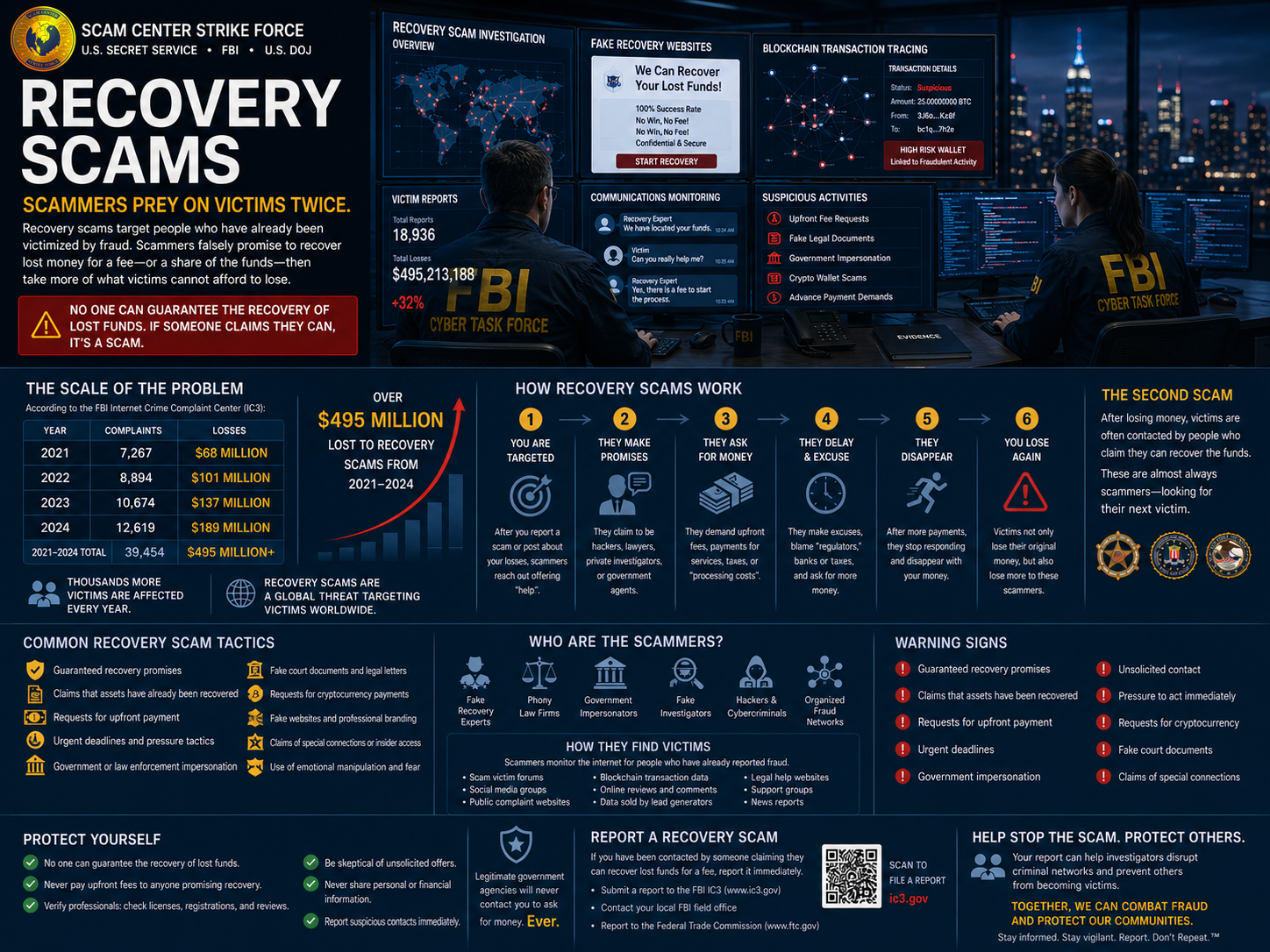
Scammed Twice: How Fraudsters Target Victims Again
Recovery scams have become one of the fastest-growing secondary fraud schemes in the United States. These scams specifically target individuals who have already lost money to cryptocurrency fraud, investment scams, romance scams, or online financial crimes.
Fraudsters exploit victims’ desperation to recover lost funds by falsely claiming they can retrieve stolen assets, freeze criminal accounts, trace cryptocurrency transactions, or secure compensation through government agencies and law enforcement partnerships.
In reality, recovery scammers are often connected to the same criminal networks responsible for the original fraud.
The Rise of Recovery Fraud
As cryptocurrency-related scams continue to generate billions of dollars in losses annually, a second wave of fraud has emerged.
Recovery scammers actively search for:
- Scam victim forums
- Social media groups
- Public complaint websites
- Blockchain transaction records
- Online reports from fraud victims
- Consumer protection discussions
Once identified, victims are contacted by individuals claiming to be investigators, attorneys, blockchain specialists, government officials, cybersecurity experts, or asset recovery professionals.
Why Recovery Scams Are Growing
Federal investigators have reported that thousands of scam victims are targeted a second time after reporting losses.
Many victims are approached within weeks of:
- Filing complaints
- Reporting scams online
- Posting on social media
- Seeking legal assistance
- Joining support groups
Criminals understand that victims are emotionally vulnerable and eager to recover their money.
This makes them highly attractive targets.
How Recovery Scams Work
Stage 1: The Contact
Victims receive:
- Emails
- WhatsApp messages
- Telegram messages
- Phone calls
- Social media messages
- Fake legal notices
The fraudster often claims:
“We have located your stolen funds.”
or
“Your cryptocurrency has been traced and frozen.”
or
“We are working with federal authorities to recover victim assets.”
Stage 2: Establishing Credibility
Scammers create the appearance of legitimacy through:
- Professional websites
- Government logos
- Fake legal documents
- Blockchain reports
- Asset tracing screenshots
- Investigator credentials
- Recovery certificates
Many victims believe they are communicating with legitimate organizations.
Stage 3: The Recovery Promise
Victims are told:
- Their funds have been located.
- Assets are ready for release.
- A court order has been obtained.
- A frozen account has been identified.
- Cryptocurrency has been recovered.
The scammer claims only one final step remains before payment can be released.
Stage 4: The Fee Request
The victim is asked to pay:
- Administrative fees
- Legal expenses
- Court costs
- Tax obligations
- Wallet activation fees
- Blockchain verification charges
- International transfer fees
- Insurance payments
The amount may range from hundreds to tens of thousands of dollars.
Stage 5: Continued Extraction
After payment is made, additional fees appear.
Victims may be asked for:
- More taxes
- Additional verification
- Anti-money laundering clearance
- Security deposits
- Transfer authorizations
The cycle continues until the victim stops paying.
No funds are ever recovered.
Cryptocurrency Recovery Fraud
Cryptocurrency recovery scams have become particularly common.
Fraudsters often claim they can:
- Trace blockchain transactions
- Reverse cryptocurrency transfers
- Unlock frozen wallets
- Recover lost private keys
- Access seized assets
- Work directly with exchanges
While blockchain analysis can sometimes identify transaction paths, legitimate recovery efforts rarely guarantee results and never require repeated advance payments.
Any promise of guaranteed recovery should be considered suspicious.
Connections to Organized Crime
Investigations have revealed that some recovery scams are operated by:
- The original scam organization
- Affiliate fraud networks
- Criminal lead-sharing groups
- Organized cybercrime syndicates
Victim information is often sold or exchanged among fraud groups.
This means individuals who have already lost money frequently become targets again.
The Numbers Behind the Problem
Recovery scams continue to increase alongside cryptocurrency fraud.
Federal agencies report:
- Billions of dollars in annual cryptocurrency fraud losses.
- Thousands of victims seeking recovery assistance each year.
- Significant increases in recovery-related complaints.
- Growing activity on social media and messaging platforms promoting asset recovery services.
Consumer protection organizations consistently identify recovery fraud as one of the most common secondary scams affecting fraud victims.
Common Recovery Scam Tactics
Warning Signs
| ⚠ Guaranteed recovery promises. | ⚠ Claims that assets have already been recovered. |
| ⚠ Requests for upfront payment. | ⚠ Urgent deadlines. |
| ⚠ Government impersonation. | ⚠ Unsolicited contact. |
| ⚠ Pressure to act immediately. | ⚠ Requests for cryptocurrency payments. |
| ⚠ Fake court documents. | ⚠ Claims of special law enforcement connections. |
If multiple warning signs are present, the offer should be treated as highly suspicious.
Fake Government Impersonation
Recovery scammers often pretend to represent:
- Federal agencies
- Financial regulators
- International organizations
- Cybercrime task forces
- Consumer protection agencies
- Legal departments
Victims should independently verify all communications before providing money or personal information.
Legitimate government agencies do not guarantee recovery of funds in exchange for advance payments.
Why Victims Fall for Recovery Scams
Recovery fraud is effective because it targets people during a period of emotional distress.
Victims may experience:
- Financial desperation
- Regret
- Anxiety
- Fear
- Hope of recovery
- Pressure from family obligations
Scammers exploit these emotions to create urgency and manipulate decision-making.
Protecting Yourself
Before engaging with any recovery service:
| ✓ Verify company registration. | ✓ Research independent reviews. |
| ✓ Be skeptical of guarantees. | ✓ Confirm professional credentials. |
| ✓ Avoid cryptocurrency payments. | ✓ Never pay large upfront fees. |
| ✓ Verify claims independently. | ✓ Consult trusted legal or financial professionals. |
Public Safety Advisory
The Scam Center Strike Force warns the public that legitimate asset recovery efforts are complex and often require extensive investigation.
No individual or company can guarantee the recovery of stolen cryptocurrency or funds.
Victims should exercise caution when approached by anyone claiming to have already recovered their assets.
Remember:
If someone promises guaranteed recovery for an upfront fee, it is likely another scam.
Report Suspicious Activity
If you have been contacted by an individual or organization claiming to recover stolen funds, preserve:
- Emails
- Text Messages
- WhatsApp Conversations
- Telegram Chats
- Wallet Addresses
- Payment Requests
- Contracts
- Screenshots
- Recovery Websites
Reporting recovery scams helps investigators identify emerging fraud networks and prevent additional victims from suffering financial harm.